- Rozmiar czcionki
- Tłumacz PJM
- Dostępność UŁ
UNIC
UNIC Mathematics Summer School 2026
Date: June 2026
Place: Łódź, Poland
Rationale:
This Summer School will focus on Finite quantum groups, Lie groups, Spectral graph theory and C*algebras.
It will contribute to developing students’ understanding around these topics and serve to introduce them to peers across participating UNIC institutions, namely, Koc University, University College Cork, University of Lodz, University of Oulu, University of Zagreb.
Advanced undergraduate students and 1st year graduate students are welcome to participate in this Summer School.
Summer School Highlights:
- Admitted participants will receive Mobility Grant to cover the Summer School expenses. For more information, please refer to the Admission section below.
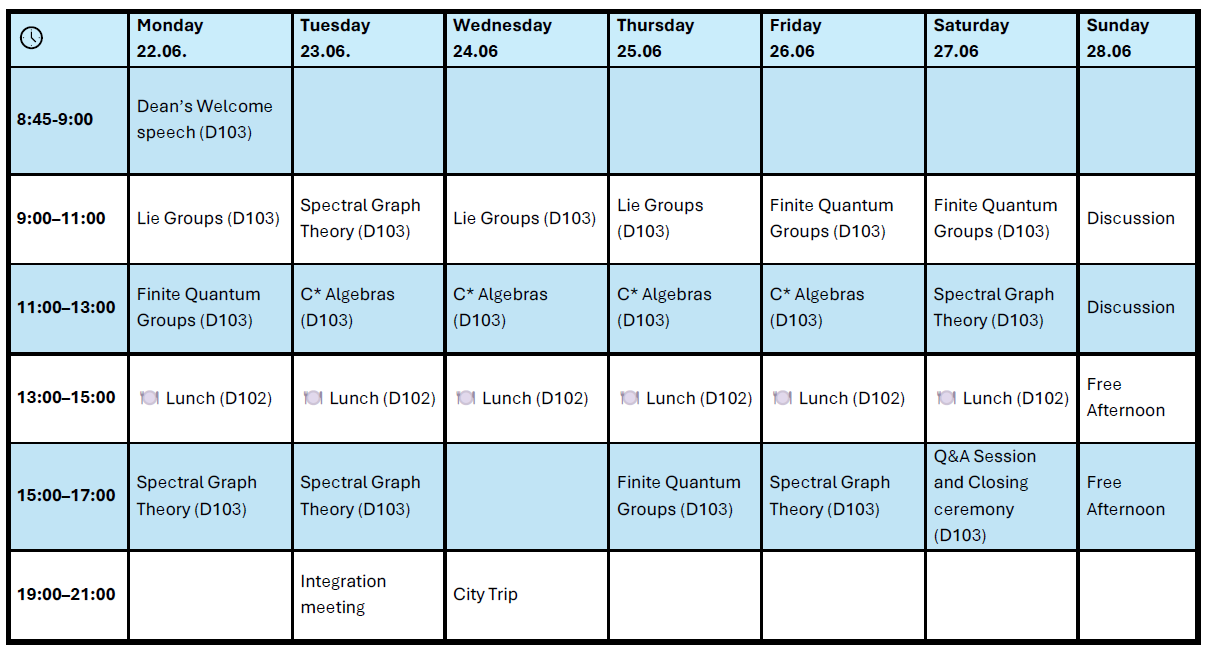
- The Summer School is organized in Łódź, Poland, from 21-28 June 2026.
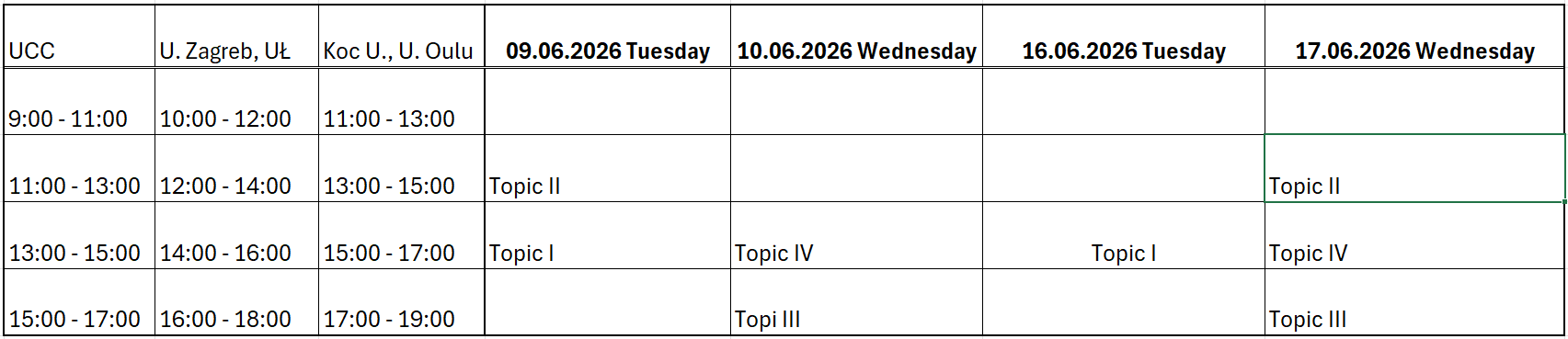
- 9-10 June 2026 and 16-17 June 2026 there will be virtual lectures (2 lectures for each of 4 topics)
- Lectures will be given by leading academics and will focuse on diverse topics:
Ben McKay (University College Cork): Lie groups
An introduction to the basic concepts of Lie groups, as symmetry groups in geometry and differential equations, exploring examples using elementary linear algebra and several variable calculus.
Hanna Podsędkowska (University of Lodz): C*- algebras
Motivated by the elegant axiomatization of quantum observables, C*-algebras offer a bridge between abstract algebra and modern physics. It will be shown how 1930s ideas still influence modern mathematics.
Pekka Salmi (University of Oulu) : Finite quantum groups
A finite quantum group, defined using Hopf *-algebras, is a generalisation of a finite group. An interesting feature of quantum groups is their duality which is connected to the Fourier transform.
Ivica Nakić (University of Zagreb): Spectral graph theory
Explore the beautiful fusion of analysis, combinatorics and algebra that forms spectral graph theory where the spectra of operators serve as a unifying lens to decode the intrinsic geometry and deepest combinatorial properties of graphs.
Admission
The Summer School is mostly free of charge (no tuition fees; participants can ask for mobility grant support from their home university. Please contact the international office of your home university for information). It is reserved for undergraduate students have received at least 60 ECTS credits in mathematical courses or for 1st year graduate students.
What can you expect in return?
The whole process involves
- undertaking virtual component of Summer School
- taking part in the Summer School
- submitting the report for the assigned project.
Having completed the process, you will be granted an official enrollment document stating that you received 5 (ECTS) credits for having succeeded in a University of Lodz advanced course.
It will then be necessary for you to approach your own home university to see how these 5 credits might fit into your program.
Programme overview for the virtual lectures
9-10 June, 2026, Tuesday and Wednesday, 4 x virtual lecture (2 hours) : Review of Course Material
16-17 June, 2026, Tuesday and Wednesday, 4 x virtual lecture (2 hours): Introduction to the Topic
Programme overview for 21-28 June 2026
Sunday June 21: Arrival to Lodz University Campus
Topic I: Lie groups
Topic II: Finite quantum groups
Topic III: Spectral graph theory
Topic IV: C* algebras
You can download the detailed syllabus of the course
Getting there
Łódź Airport provides convenient direct flights from Dublin, London, and Antalya. For more options, you can also fly into Warsaw Chopin Airport and enjoy a comfortable train ride straight to the heart of Łódź.
The event will take place at the Faculty of Mathematics and Computer Science, Banacha 22
90-238 Łódź, Poland. The accommodation will be organized at student dormitories of University of Lodz.
Accommodation options
Dormitories on the University Campus
Location:
Most student dormitories are located in the very heart of Łódź, in the “Lumumbowo” residential area, close to the city center, Manufaktura, and major public transport hubs.
Room types:
Single, double, and triple rooms are available. In dormitories No. 10, 11, 13, and 14, rooms are arranged in a studio-style layout.
Bathrooms:
In most dormitories, bathrooms and toilets are located inside the rooms. In studio-type rooms, a bathroom and kitchenette are shared between two rooms.
Equipment:
Rooms are fully furnished (beds, desks, chairs, wardrobes).
Kitchens:
Shared kitchens for self-catering are available on each floor or in designated common areas.
Additional amenities:
Most dormitories offer access to Wi-Fi, laundry rooms, drying rooms, and study rooms.
Organizers
The UNIC Mathematics Summer School is organized by the European University of Post-Industrial Cities (UNIC) network. UNIC network consists of ten universities situated in different countries throughout Europe representing ten different post-industrial cities. Among those 10 universities, 5 contribute to the Summer School.
Organizing committee
- Mine Çağlar, Koc University
- Spyridon Dendrinos, University College Cork
- Bernard Hanzon, University College Cork
- Ivica Nakić, University of Zagreb
- Pekka Salmi, University of Oulu
- Aleksandra Orpel, University of Lodz
Hanna Podsędkowska, University of Lodz



Projekt Multiportalu UŁ współfinansowany z funduszy Unii Europejskiej w ramach konkursu NCBR